




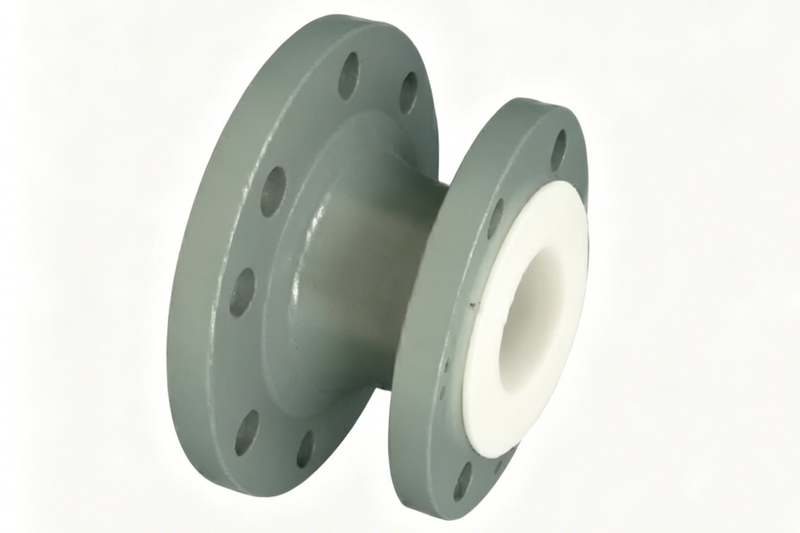
PTFE Lined Reducer
Core Overview
PTFE Lined Reducer is a corrosion-resistant pipe fitting widely used in chemical, pharmaceutical, metallurgical, and environmental protection industries. It features a PTFE lining inside a carbon steel or stainless steel shell, combining the corrosion resistance of PTFE with the mechanical strength of metal, making it ideal for transporting corrosive media such as acids, alkalis, salts, and organic solvents.
Basic Specifications
| Item | Details |
| Product Name | PTFE (Polytetrafluoroethylene) Lined Reducer |
| Executive Standards | HG/T 21562, ASME B16.5, GB/T 12224 |
| Nominal Diameter | DN15 – DN300 (1/2" – 12") |
| Pressure Rating | PN10, PN16, PN25, PN40 / Class 150, Class 300 |
| Structure Type | Concentric Reducer, Eccentric Reducer |
| Shell Material | Carbon Steel (Q235B, 20#), Stainless Steel (304, 316L) |
| Lining Material | Polytetrafluoroethylene (PTFE) |
| Lining Thickness | 2.0–6.0 mm (Standard: 3.0–4.0 mm) |
| Connection Type | Flanged Connection (RF Raised Face, FM Female Face) |
| Operating Temperature | -20℃ to +180℃ |
| Applicable Medium | Strong acids, strong alkalis, oxidants, organic solvents and other highly corrosive media |
| Factory Inspection | Hydrostatic pressure test, Spark pinhole leakage test (5kV) |
| Main Applications | Chemical, petrochemical, pharmaceutical, metallurgy, environmental protection, fluorine chemical, sewage treatment industries |
Typical Dimensions Table
| Nominal Diameter (Large×Small) DN | Outer Diameter (mm) | Length (mm) | Flange Outer Diameter (mm) | Bolt Circle Diameter (mm) | Lining Thickness (mm) |
| 25×15 | 33.7×21.3 | 100 | 115/90 | 80/60 | 3.0 |
| 32×25 | 42.4×33.7 | 120 | 140/115 | 100/80 | 3.5 |
| 40×25 | 48.3×33.7 | 130 | 150/115 | 110/80 | 3.5 |
| 40×32 | 48.3×42.4 | 130 | 150/140 | 110/100 | 3.5 |
| 50×32 | 60.3×42.4 | 150 | 165/140 | 125/100 | 4.0 |
| 50×40 | 60.3×48.3 | 150 | 165/150 | 125/110 | 4.0 |
| 65×50 | 76.1×60.3 | 180 | 185/165 | 145/125 | 4.0 |
| 80×50 | 88.9×60.3 | 200 | 200/165 | 160/125 | 4.0 |
| 80×65 | 88.9×76.1 | 200 | 200/185 | 160/145 | 4.0 |
| 100×65 | 114.3×76.1 | 220 | 220/185 | 180/145 | 4.5 |
| 100×80 | 114.3×88.9 | 220 | 220/200 | 180/160 | 4.5 |
| 150×100 | 168.3×114.3 | 280 | 285/220 | 240/180 | 5.0 |
| 200×150 | 219.1×168.3 | 340 | 340/285 | 295/240 | 5.5 |
| 250×200 | 273.0×219.1 | 400 | 405/340 | 355/295 | 6.0 |
| 300×250 | 323.9×273.0 | 450 | 460/405 | 410/355 | 6.0 |
Core Advantages
|
Advantage Category |
Specific Content |
| Corrosion Resistance | PTFE lining can resist corrosion from most acids, alkalis, and organic solvents, with a corrosion resistance coefficient of up to 0.99 |
| Low Friction | The friction coefficient of PTFE is only 0.04, which reduces the resistance of fluid transportation and saves energy |
| Temperature Resistance | Can work stably in the temperature range of -200℃ to 260℃, suitable for high and low-temperature environments |
| Non-Stick Property | The surface of PTFE is non-stick, which prevents medium deposition and facilitates cleaning |
| Long Service Life | The service life is 3-5 times longer than that of ordinary pipe fittings, reducing maintenance costs |