




0102030405
PTFE Lined Pipe from China Suppliers - Durable Factory Solutions for Corrosive Media Conveyance
Core Overview
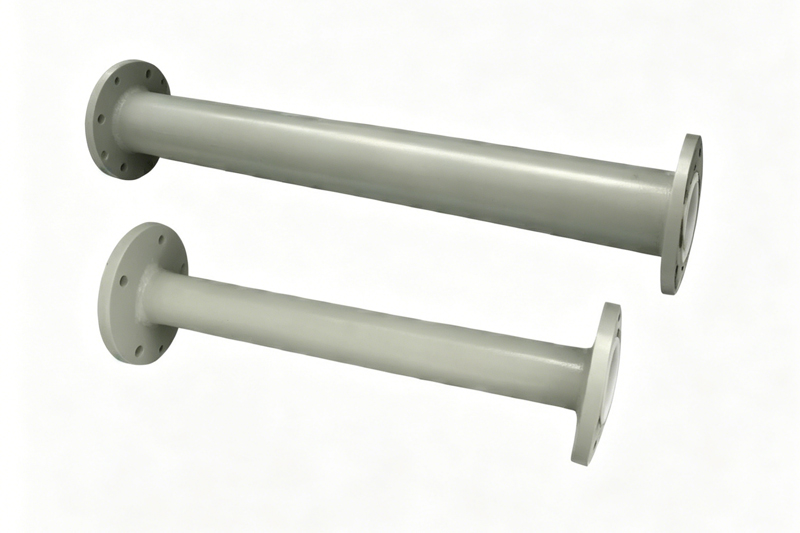
PTFE-lined pipe is a high-performance composite pipeline integrating the structural robustness of carbon steel/stainless steel with the exceptional chemical inertness of polytetrafluoroethylene (PTFE). Engineered to safely transport aggressive media like strong acids, alkalis, and oxidants, it is a staple in petroleum, chemical, pharmaceutical, and food processing industries. Its seamless bonding of metal and PTFE ensures reliable operation across extreme temperature and pressure ranges, eliminating contamination risks and extending service life.
Basic Specifications
| Item | Details |
|---|---|
| Product Name | PTFE (Polytetrafluoroethylene) Lined Pipe |
| Executive Standards | HG/T 21562, ASME B16.5, GB/T 12224 |
| Nominal Diameter | DN15 – DN300 (1/2" – 12") |
| Pressure Rating | PN10, PN16, PN25, PN40 / Class 150, Class 300 |
| Pipe Type | Straight seamless lined pipe |
| Shell Material | Carbon Steel (Q235B, 20#), Stainless Steel (304, 316L) |
| Lining Material | Polytetrafluoroethylene (PTFE) |
| Lining Thickness | 2.0–6.0 mm (Standard: 3.0–4.0 mm) |
| Connection Type | Flanged Connection (RF Raised Face) |
| Standard Length | 1000mm / 2000mm (Custom length available) |
| Operating Temperature | -20℃ to +180℃ |
| Applicable Medium | Strong acids, strong alkalis, oxidants, organic solvents and other highly corrosive media |
| Factory Inspection | Hydrostatic pressure test, Spark pinhole leakage test (5kV) |
| Main Applications | Chemical, petrochemical, pharmaceutical, metallurgy, environmental protection, fluorine chemical industry |
Typical Dimensions Table
| Nominal Diameter DN | Steel Pipe Outer Diameter (mm) | Standard Pipe Length (mm) | Flange Outer Diameter (mm) | Bolt Circle Diameter (mm) | Lining Thickness (mm) |
|---|---|---|---|---|---|
| 15 | 21.3 | 1000/2000 | 90 | 60 | 3.0 |
| 20 | 26.9 | 1000/2000 | 100 | 70 | 3.0 |
| 25 | 33.7 | 1000/2000 | 115 | 80 | 3.5 |
| 32 | 42.4 | 1000/2000 | 140 | 100 | 3.5 |
| 40 | 48.3 | 1000/2000 | 150 | 110 | 3.5 |
| 50 | 60.3 | 1000/2000 | 165 | 125 | 4.0 |
| 65 | 76.1 | 1000/2000 | 185 | 145 | 4.0 |
| 80 | 88.9 | 1000/2000 | 200 | 160 | 4.0 |
| 100 | 114.3 | 1000/2000 | 220 | 180 | 4.5 |
| 125 | 139.7 | 1000/2000 | 250 | 210 | 4.5 |
| 150 | 168.3 | 1000/2000 | 285 | 240 | 5.0 |
| 200 | 219.1 | 1000/2000 | 340 | 295 | 5.5 |
| 250 | 273.0 | 1000/2000 | 405 | 355 | 6.0 |
| 300 | 323.9 | 1000/2000 | 460 | 410 | 6.0 |
Core Advantages
Extreme Corrosion Resistance
Inert to 99% of industrial chemicals, preventing pipeline degradation and media contamination.
Wide Temperature Tolerance
Operates stably from -100°C to 250°C, suitable for cryogenic to high-temperature processes.
Low-Friction Hydraulics
Ultra-smooth inner surface reduces flow resistance by 30% vs. steel, preventing scaling.
Pressure & Vacuum Stability
Withstands up to 3.0MPa positive pressure and -0.96MPa vacuum, adapting to diverse industrial systems.
Long-Term Durability
Minimal maintenance required, with a 50+ year lifespan under standard operating conditions.
Frequently Asked Questions
What are the primary materials used in PTFE-lined pipes?
The outer shell is typically constructed from robust Carbon Steel (such as Q235B or 20#) or Stainless Steel (such as 304 or 316L), while the inner lining is made of premium Polytetrafluoroethylene (PTFE) for outstanding chemical resistance.
What is the standard operating temperature range for these pipes?
Our standard PTFE-lined pipes are designed to operate reliably within a temperature range of -20℃ to +180℃, though the material itself can withstand extreme temperatures from -100°C to 250°C under specific system designs.
Which standards do your PTFE-lined pipes comply with?
All pipes are manufactured and inspected in strict accordance with recognized executive standards, including HG/T 21562, ASME B16.5, and GB/T 12224.
How is the quality and safety of the lining verified before delivery?
Every batch undergoes rigorous factory inspections, including a hydrostatic pressure test to verify structural integrity and a high-voltage Spark Pinhole Leakage Test (5kV) to ensure the lining is completely seamless and defect-free.
What connection methods are used for installation?
These pipelines utilize a standard Flanged Connection with a Raised Face (RF) design, ensuring secure, leak-free joints capable of handling both high pressure and vacuum conditions.