




0102030405
PTFE Lined Pipe from China Suppliers | Durable and Corrosion-Resistant Piping Solutions by Ruitu Automation Factory
Core Overview
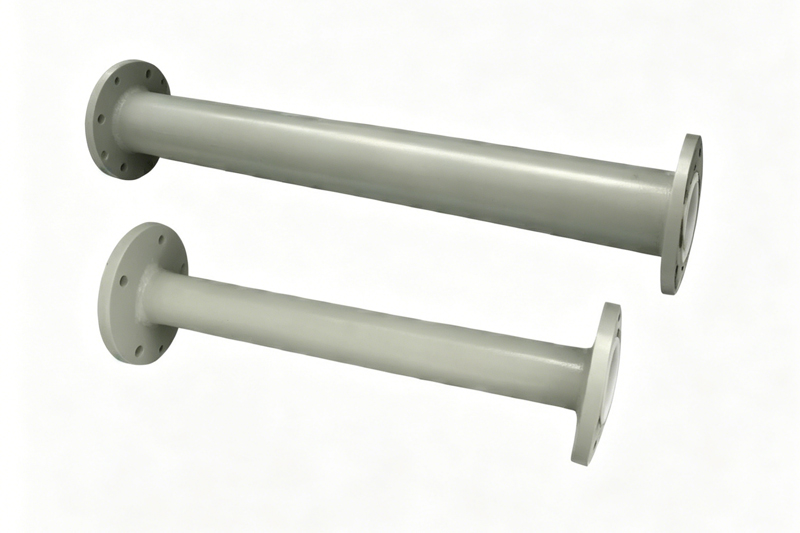
PTFE-lined pipe is a high-performance composite pipeline integrating the structural robustness of carbon steel/stainless steel with the exceptional chemical inertness of polytetrafluoroethylene (PTFE). Engineered to safely transport aggressive media like strong acids, alkalis, and oxidants, it is a staple in petroleum, chemical, pharmaceutical, and food processing industries. Its seamless bonding of metal and PTFE ensures reliable operation across extreme temperature and pressure ranges, eliminating contamination risks and extending service life.
Basic Specifications
| Item | Details |
| Product Name | PTFE (Polytetrafluoroethylene) Lined Pipe |
| Executive Standards | HG/T 21562, ASME B16.5, GB/T 12224 |
| Nominal Diameter | DN15 – DN300 (1/2" – 12") |
| Pressure Rating | PN10, PN16, PN25, PN40 / Class 150, Class 300 |
| Pipe Type | Straight seamless lined pipe |
| Shell Material | Carbon Steel (Q235B, 20#), Stainless Steel (304, 316L) |
| Lining Material | Polytetrafluoroethylene (PTFE) |
| Lining Thickness | 2.0–6.0 mm (Standard: 3.0–4.0 mm) |
| Connection Type | Flanged Connection (RF Raised Face) |
| Standard Length | 1000mm / 2000mm (Custom length available) |
| Operating Temperature | -20℃ to +180℃ |
| Applicable Medium | Strong acids, strong alkalis, oxidants, organic solvents and other highly corrosive media |
| Factory Inspection | Hydrostatic pressure test, Spark pinhole leakage test (5kV) |
| Main Applications | Chemical, petrochemical, pharmaceutical, metallurgy, environmental protection, fluorine chemical industry |
Typical Dimensions Table
| Nominal Diameter DN | Steel Pipe Outer Diameter (mm) | Standard Pipe Length (mm) | Flange Outer Diameter (mm) | Bolt Circle Diameter (mm) | Lining Thickness (mm) |
| 15 | 21.3 | 1000/2000 | 90 | 60 | 3.0 |
| 20 | 26.9 | 1000/2000 | 100 | 70 | 3.0 |
| 25 | 33.7 | 1000/2000 | 115 | 80 | 3.5 |
| 32 | 42.4 | 1000/2000 | 140 | 100 | 3.5 |
| 40 | 48.3 | 1000/2000 | 150 | 110 | 3.5 |
| 50 | 60.3 | 1000/2000 | 165 | 125 | 4.0 |
| 65 | 76.1 | 1000/2000 | 185 | 145 | 4.0 |
| 80 | 88.9 | 1000/2000 | 200 | 160 | 4.0 |
| 100 | 114.3 | 1000/2000 | 220 | 180 | 4.5 |
| 125 | 139.7 | 1000/2000 | 250 | 210 | 4.5 |
| 150 | 168.3 | 1000/2000 | 285 | 240 | 5.0 |
| 200 | 219.1 | 1000/2000 | 340 | 295 | 5.5 |
| 250 | 273.0 | 1000/2000 | 405 | 355 | 6.0 |
| 300 | 323.9 | 1000/2000 | 460 | 410 | 6.0 |
Core Advantages
| Advantage Category | Key Benefits |
| Extreme Corrosion Resistance | Inert to 99% of industrial chemicals, preventing pipeline degradation and media contamination. |
| Wide Temperature Tolerance | Operates stably from -100°C to 250°C, suitable for cryogenic to high-temperature processes. |
| Low-Friction Hydraulics | Ultra-smooth inner surface reduces flow resistance by 30% vs. steel pipes, preventing scaling. |
| Pressure & Vacuum Stability | Withstands up to 3.0MPa positive pressure and -0.96MPa vacuum, adapting to diverse industrial systems. |
| Long-Term Durability | Minimal maintenance required, with a 50+ year lifespan under standard operating conditions. |
Frequently Asked Questions (FAQ)
What materials are used for the shell and lining of these pipes?
The outer shell is constructed from Carbon Steel (Q235B, 20#) or Stainless Steel (304, 316L), while the inner lining is made of high-performance Polytetrafluoroethylene (PTFE).
What is the standard operating temperature range for PTFE-lined pipes?
The standard operating temperature ranges from -20℃ to +180℃, though the core material can stably tolerate extreme temperatures from -100°C up to 250°C.
Which quality inspection tests do these pipes undergo before leaving the factory?
Every pipe undergoes strict factory inspections, including a hydrostatic pressure test and a Spark pinhole leakage test conducted at 5kV.
What pressure limits can the PTFE-lined pipeline withstand?
These pipelines are engineered to withstand positive pressures up to 3.0MPa and negative/vacuum pressures down to -0.96MPa.
What are the standard lining thicknesses for different pipe diameters?
The lining thickness generally ranges from 2.0mm to 6.0mm. For instance, smaller diameters like DN15 use a 3.0mm lining, while larger diameters like DN300 feature up to a 6.0mm lining thickness.