




PTFE Lined Pipe from China - Premium Suppliers and Factory for Corrosive Media Conveyance
Core Overview
Basic Specifications
| Item | Details |
|---|---|
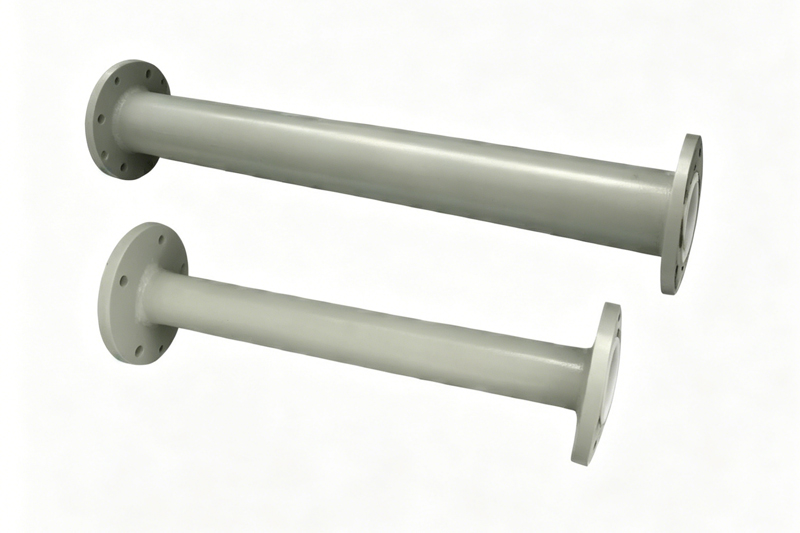
| Product Name | PTFE (Polytetrafluoroethylene) Lined Pipe |
| Executive Standards | HG/T 21562, ASME B16.5, GB/T 12224 |
| Nominal Diameter | DN15 – DN300 (1/2" – 12") |
| Pressure Rating | PN10, PN16, PN25, PN40 / Class 150, Class 300 |
| Pipe Type | Straight seamless lined pipe |
| Shell Material | Carbon Steel (Q235B, 20#), Stainless Steel (304, 316L) |
| Lining Material | Polytetrafluoroethylene (PTFE) |
| Lining Thickness | 2.0–6.0 mm (Standard: 3.0–4.0 mm) |
| Connection Type | Flanged Connection (RF Raised Face) |
| Standard Length | 1000mm / 2000mm (Custom length available) |
| Operating Temperature | -20℃ to +180℃ |
| Applicable Medium | Strong acids, strong alkalis, oxidants, organic solvents and other highly corrosive media |
| Factory Inspection | Hydrostatic pressure test, Spark pinhole leakage test (5kV) |
| Main Applications | Chemical, petrochemical, pharmaceutical, metallurgy, environmental protection, fluorine chemical industry |
Typical Dimensions Table
| Nominal Diameter DN | Steel Pipe Outer Diameter (mm) | Standard Pipe Length (mm) | Flange Outer Diameter (mm) | Bolt Circle Diameter (mm) | Lining Thickness (mm) |
|---|---|---|---|---|---|
| 15 | 21.3 | 1000/2000 | 90 | 60 | 3.0 |
| 20 | 26.9 | 1000/2000 | 100 | 70 | 3.0 |
| 25 | 33.7 | 1000/2000 | 115 | 80 | 3.5 |
| 32 | 42.4 | 1000/2000 | 140 | 100 | 3.5 |
| 40 | 48.3 | 1000/2000 | 150 | 110 | 3.5 |
| 50 | 60.3 | 1000/2000 | 165 | 125 | 4.0 |
| 65 | 76.1 | 1000/2000 | 185 | 145 | 4.0 |
| 80 | 88.9 | 1000/2000 | 200 | 160 | 4.0 |
| 100 | 114.3 | 1000/2000 | 220 | 180 | 4.5 |
| 125 | 139.7 | 1000/2000 | 250 | 210 | 4.5 |
| 150 | 168.3 | 1000/2000 | 285 | 240 | 5.0 |
| 200 | 219.1 | 1000/2000 | 340 | 295 | 5.5 |
| 250 | 273.0 | 1000/2000 | 405 | 355 | 6.0 |
| 300 | 323.9 | 1000/2000 | 460 | 410 | 6.0 |
Core Advantages
| Advantage Category | Key Benefits |
|---|---|
| Extreme Corrosion Resistance | Inert to 99% of industrial chemicals, preventing pipeline degradation and media contamination. |
| Wide Temperature Tolerance | Operates stably from -100°C to 250°C, suitable for cryogenic to high-temperature processes. |
| Low-Friction Hydraulics | Ultra-smooth inner surface reduces flow resistance by 30% vs. steel, preventing scaling. |
| Pressure & Vacuum Stability | Withstands up to 3.0MPa positive pressure and -0.96MPa vacuum, adapting to diverse industrial systems. |
| Long-Term Durability | Minimal maintenance required, with a 50+ year lifespan under standard operating conditions. |
Frequently Asked Questions (FAQ)
Q1 What media are PTFE-lined pipes best suited for?
PTFE-lined pipes are engineered to handle aggressive and corrosive industrial media, including strong acids (such as sulfuric, hydrochloric, and nitric acid), strong alkalis, oxidants, and organic solvents, while eliminating media contamination risks.
Q2 What is the operating temperature range for these pipes?
The standard operating temperature ranges from -20℃ to +180℃. Under specific design and process parameters, the wide thermal tolerance of PTFE lining allows stable operation across temperatures spanning from -100°C up to 250°C.
Q3 What standards and pressure classes are available?
The pipelines comply with international standards such as HG/T 21562, ASME B16.5, and GB/T 12224. They support pressure ratings including PN10, PN16, PN25, PN40, as well as ASME Class 150 and Class 300 ratings.
Q4 How is liner integrity tested before delivery?
All straight lined pipes undergo rigorous factory quality control inspections, including hydrostatic pressure testing to verify mechanical strength and a non-destructive 5kV spark pinhole leakage test to guarantee zero pinhole defects in the lining.
Q5 Can PTFE-lined pipes handle vacuum operating conditions?
Yes. Owing to precision seamless bonding techniques, these pipes maintain structural stability under working pressures up to 3.0MPa positive pressure and full/partial vacuum environments down to -0.96MPa without lining collapse.
Q6 Are customized lengths and outer materials available?
Standard lengths are 1000mm and 2000mm with nominal diameters from DN15 to DN300 (1/2" to 12"). Custom spool lengths and pipe shell options (Carbon Steel Q235B/20# or Stainless Steel 304/316L) are fully available to match site layout specifications.