




0102030405
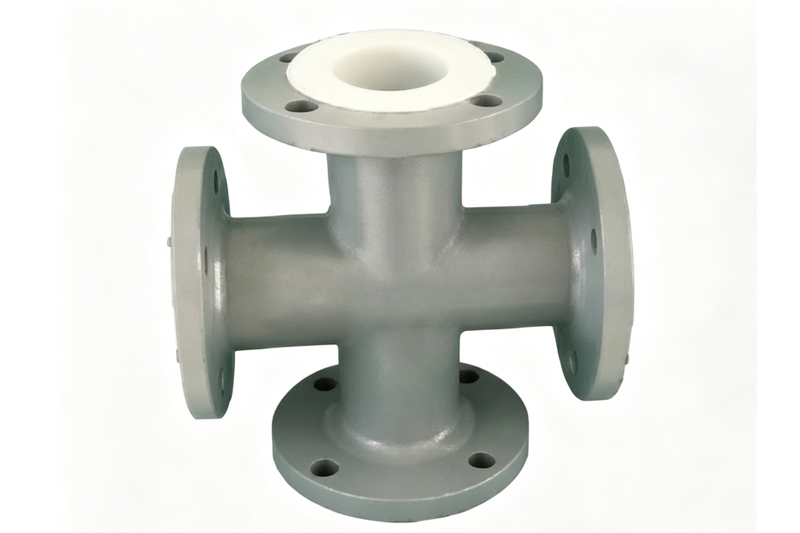
PTFE Lined Four-Way Cross Fitting from China Suppliers - Durable Factory Connection for Corrosive Fluids
Core Overview
PTFE Lined Four-Way Fitting is a corrosion-resistant pipe fitting widely used in chemical, pharmaceutical, metallurgical, and environmental protection industries. It features a PTFE lining inside a carbon steel or stainless steel shell, combining the corrosion resistance of PTFE with the mechanical strength of metal, making it ideal for transporting corrosive media such as acids, alkalis, salts, and organic solvents.
Basic Specifications
| Item | Details |
|---|---|
| Product Name | PTFE Lined Four-Way |
| Executive Standards | HG/T 21562, ASME B16.5, GB/T 12224 |
| Nominal Diameter | DN15 – DN300 (1/2" – 12") |
| Pressure Rating | PN10, PN16, PN25, PN40 / Class 150, Class 300 |
| Structure Type | Equal Cross, Reducing Cross |
| Shell Material | Carbon Steel (Q235B, 20#), Stainless Steel (304, 316L) |
| Lining Material | Polytetrafluoroethylene (PTFE) |
| Lining Thickness | 2.0–6.0 mm (Standard: 3.0–4.0 mm) |
| Connection Type | Flanged Connection (RF Raised Face, FM Female Face) |
| Operating Temperature | -20℃ to +180℃ |
| Applicable Medium | Strong acids, strong alkalis, oxidants, organic solvents and other highly corrosive media |
| Factory Inspection | Hydrostatic pressure test, Spark pinhole leakage test (5kV) |
| Main Applications | Chemical, petrochemical, pharmaceutical, metallurgy, environmental protection, fluorine chemical, sewage treatment industries |
Typical Dimensions Table
| Nominal Diameter DN | Outer Diameter (mm) | Center-to-End (mm) | Flange Outer Diameter (mm) | Bolt Circle Diameter (mm) | Lining Thickness (mm) |
|---|---|---|---|---|---|
| 15 | 21.3 | 40 | 90 | 60 | 3.0 |
| 20 | 26.9 | 50 | 100 | 70 | 3.0 |
| 25 | 33.7 | 65 | 115 | 80 | 3.5 |
| 32 | 42.4 | 80 | 140 | 100 | 3.5 |
| 40 | 48.3 | 100 | 150 | 110 | 3.5 |
| 50 | 60.3 | 125 | 165 | 125 | 4.0 |
| 65 | 76.1 | 160 | 185 | 145 | 4.0 |
| 80 | 88.9 | 190 | 200 | 160 | 4.0 |
| 100 | 114.3 | 250 | 220 | 180 | 4.5 |
| 125 | 139.7 | 310 | 250 | 210 | 4.5 |
| 150 | 168.3 | 380 | 285 | 240 | 5.0 |
| 200 | 219.1 | 500 | 340 | 295 | 5.5 |
| 250 | 273.0 | 630 | 405 | 355 | 6.0 |
| 300 | 323.9 | 750 | 460 | 410 | 6.0 |
Core Advantages
| Advantage Category | Specific Content |
|---|---|
| Corrosion Resistance | PTFE lining can resist corrosion from most acids, alkalis, and organic solvents, with a corrosion resistance coefficient of up to 0.99 |
| Low Friction | The friction coefficient of PTFE is only 0.04, which reduces the resistance of fluid transportation and saves energy |
| Temperature Resistance | Can work stably in the temperature range of -200℃ to 260℃, suitable for high and low-temperature environments |
| Non-Stick Property | The surface of PTFE is non-stick, which prevents medium deposition and facilitates cleaning |
| Long Service Life | The service life is 3-5 times longer than that of ordinary pipe fittings, reducing maintenance costs |
Frequently Asked Questions (FAQ)
What are the main benefits of using a PTFE Lined Four-Way Fitting?
It combines the high mechanical strength of a metal outer shell (carbon steel or stainless steel) with the exceptional chemical corrosion resistance of a PTFE inner lining. This makes it highly durable and safe for transporting aggressive chemicals.
What is the typical operating temperature range for these fittings?
The standard operating temperature range for the assembled PTFE Lined Four-Way Fitting is -20℃ to +180℃, which satisfies the requirements of most chemical process piping systems.
Which industries commonly use PTFE Lined Four-Way Fittings?
They are extensively used in industries that handle highly corrosive media, including chemical manufacturing, petrochemical processing, pharmaceuticals, metallurgy, environmental protection, fluorine chemicals, and sewage treatment.
How are these fittings tested before leaving the factory?
To guarantee safety and prevent leakage under pressure, each fitting undergoes rigorous quality inspections, including a hydrostatic pressure test and a high-voltage spark pinhole leakage test at 5kV.
Does the PTFE lining affect fluid flow resistance?
No, actually it improves it. PTFE has an extremely low friction coefficient of 0.04, which reduces fluid resistance, saves energy during transport, and prevents media from sticking to the pipe walls.