




0102030405
PTFE-Lined Expansion Joint - Corrosion-Resistant Bellows from China Suppliers & Factory for Piping Systems
Core Overview
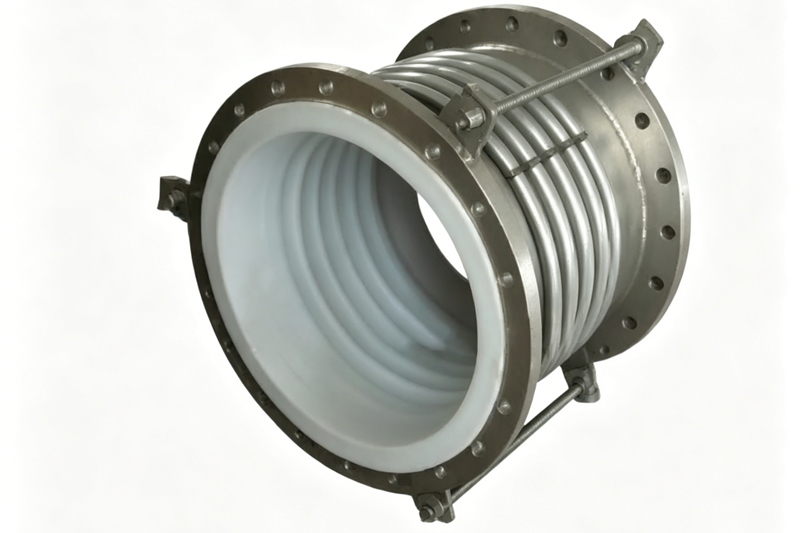
PTFE-lined expansion joints, also known as fluoroplastic bellows compensators, are critical components designed to absorb thermal expansion, vibration, and mechanical movement in piping systems handling highly corrosive media. Constructed with a multi-layered PTFE bellows core reinforced by stainless steel wire mesh or outer rings, and flanged with carbon or stainless steel, these joints provide an impermeable barrier against aggressive chemicals. They are extensively used in chemical processing, pharmaceutical manufacturing, and power generation industries where standard metal bellows would fail due to corrosion. The unique design ensures flexibility while maintaining the structural integrity required for high-pressure and vacuum applications.
Basic Specifications
| Item | Details |
| Product Name | PTFE (Polytetrafluoroethylene) Lined Expansion Joint (Compensator) |
| Executive Standards | HG/T 21562, ASME B16.5, GB/T 12224, GB/T 12777 |
| Nominal Diameter | DN15 – DN300 (1/2" – 12") |
| Pressure Rating | PN10, PN16, PN25, PN40 / Class 150, Class 300 |
| Structure Type | Axial type, Lateral type, Angular type, Universal type (with limit device optional) |
| Shell & Bellows Material | Carbon Steel (Q235B, 20#), Stainless Steel (304, 316L) |
| Lining Material | Polytetrafluoroethylene (PTFE), PFA optional for high temperature requirements |
| Lining Thickness | 2.0–6.0 mm (Standard: 3.0–4.0 mm) |
| Connection Type | Flanged Connection (RF Raised Face), Welded connection optional |
| Operating Temperature | -20℃ to +180℃ (-4°F to +356°F) |
| Core Performance | Absorb thermal expansion & contraction, pipeline displacement, mechanical vibration; reduce noise and pipeline stress |
| Applicable Medium | Strong acids, strong alkalis, strong oxidants, organic solvents and other highly corrosive media |
| Factory Inspection | Hydrostatic pressure test, Spark pinhole leakage test (5kV), Air tightness test, Cycle fatigue test |
| Main Applications | Chemical industry, petrochemical, pharmaceutical, metallurgy, environmental protection, fluorine chemical, sewage treatment industries |
Typical Dimensions Table
| Nominal Diameter DN | Bellows Outer Diameter (mm) | Free Length (mm) | Max Axial Compensation (mm) | Flange Outer Diameter (mm) | Bolt Circle Diameter (mm) | Lining Thickness (mm) |
| 15 | 24 | 120 | ±6 | 90 | 60 | 3.0 |
| 20 | 30 | 130 | ±7 | 100 | 70 | 3.0 |
| 25 | 38 | 140 | ±8 | 115 | 80 | 3.5 |
| 32 | 48 | 150 | ±9 | 140 | 100 | 3.5 |
| 40 | 58 | 160 | ±10 | 150 | 110 | 3.5 |
| 50 | 70 | 180 | ±12 | 165 | 125 | 4.0 |
| 65 | 86 | 200 | ±15 | 185 | 145 | 4.0 |
| 80 | 102 | 220 | ±18 | 200 | 160 | 4.0 |
| 100 | 120 | 240 | ±20 | 220 | 180 | 4.5 |
| 125 | 148 | 270 | ±22 | 250 | 210 | 4.5 |
| 150 | 180 | 300 | ±25 | 285 | 240 | 5.0 |
| 200 | 240 | 350 | ±30 | 340 | 295 | 5.5 |
| 250 | 300 | 400 | ±35 | 405 | 355 | 6.0 |
| 300 | 360 | 450 | ±40 | 460 | 410 | 6.0 |
Core Advantages
| Advantage | Description |
| Exceptional Chemical Resistance | Inert to almost all industrial acids, alkalis, and solvents, ensuring long-term durability in harsh environments. |
| High Flexibility & Movement Absorption | Effectively absorbs axial, lateral, and angular movements, reducing stress on connected piping and equipment. |
| Vacuum & Pressure Stability | Reinforced structure prevents bellows collapse under full vacuum and withstands significant positive pressure. |
| Low Friction & Non-Adhesive | Smooth PTFE surface prevents material buildup and scaling, maintaining consistent flow rates and reducing maintenance. |
| Thermal Insulation Properties | PTFE’s low thermal conductivity helps minimize heat loss or gain in sensitive process lines. |
Frequently Asked Questions
What are the primary applications of PTFE-lined expansion joints?
They are widely used in chemical processing, petrochemicals, pharmaceuticals, metallurgy, and sewage treatment systems where highly corrosive chemicals like strong acids, alkalis, and organic solvents are transported.
What is the operating temperature range for these joints?
The standard operating temperature ranges from -20℃ to +180℃ (-4°F to +356°F). For higher temperature requirements, PFA lining options are available.
How does the PTFE lining prevent structural failure?
The multi-layered PTFE bellows core provides an impermeable, corrosion-resistant barrier, while outer reinforcements like stainless steel wire mesh or rings provide the mechanical strength to withstand pressure and vacuum.
What connection standards do these expansion joints support?
They support standard flanged connections including HG/T 21562, ASME B16.5, GB/T 12224, and GB/T 12777. Welded connections are also available as custom options.
What quality checks do these expansion joints undergo before delivery?
Each joint undergoes strict factory inspections, including hydrostatic pressure testing, spark pinhole leakage testing (5kV), air tightness testing, and cycle fatigue testing to ensure optimal safety.