




Professional Salt Drying Machinery from China - Top Suppliers for Salt Washing Factory Solutions
Technical Characteristics
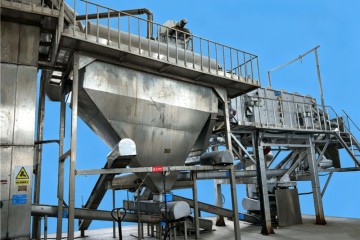
The drying section for salt washing includes a centrifugal dehydrator, an air heater, and a vibrating fluidized drying bed. The entire section features high drying efficiency, uniform moisture content, and is particularly energy-efficient, making it suitable for the production of both food-grade and industrial-grade washed salt.
Salt Drying Section: The Final Key to High-Quality Washed Salt
After cleaning and crushing, washed salt particles still contain a large amount of moisture (typically 8% - 10% water content). Excessive moisture can lead to clumping, mold growth, and difficulties in storage, transportation, and packaging - directly affecting the final product quality and market competitiveness. Our specially designed salt drying section for washed salt consists of a centrifugal dehydrator, a hot air furnace, and a vibrating fluidized drying bed, achieving efficient dehydration, uniform drying, and low energy consumption. It addresses the pain points of uneven drying, high energy consumption, salt clumping, and excessive moisture residue, ensuring that the final salt product meets customer quality standards. The entire drying system is seamlessly integrated with the preceding salt washing line, ensuring the purity and quality of the washed salt.
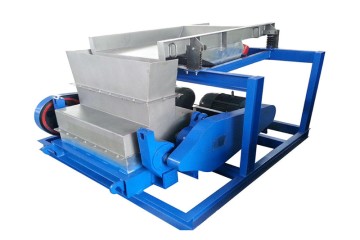
Centrifugal Dehydration (Centrifuge Dewater) - Pre-Dehydration: The washed and crushed salt particles (0.1 - 0.5 mm) are first sent to the centrifugal dehydrator. Through high-speed centrifugal force, most of the free water on the surface of the salt particles is removed, reducing the water content from 8 - 10% to 3 - 4%. This step saves energy and shortens the drying time.
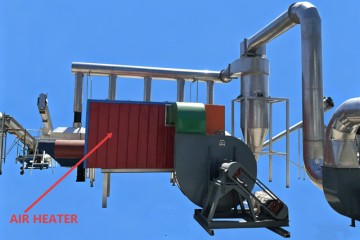
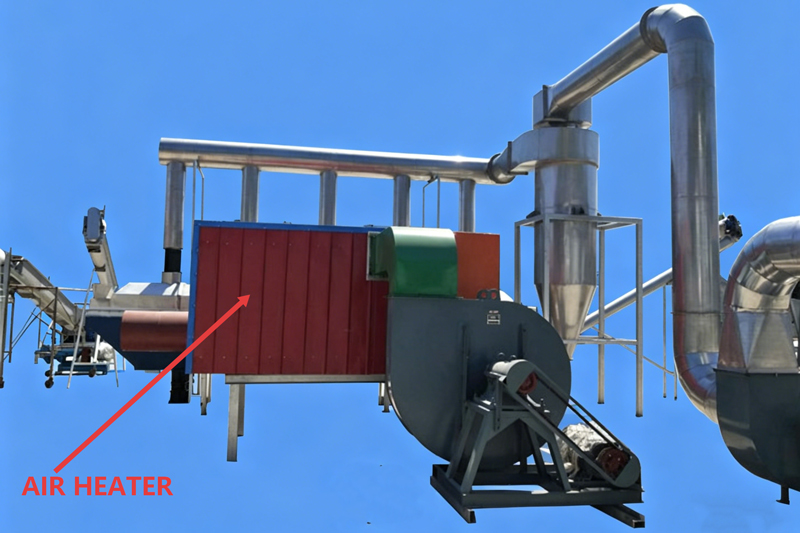
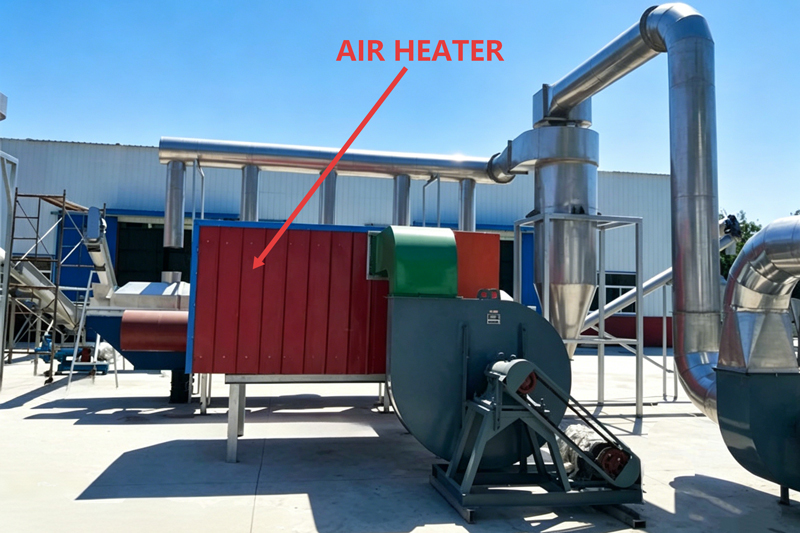
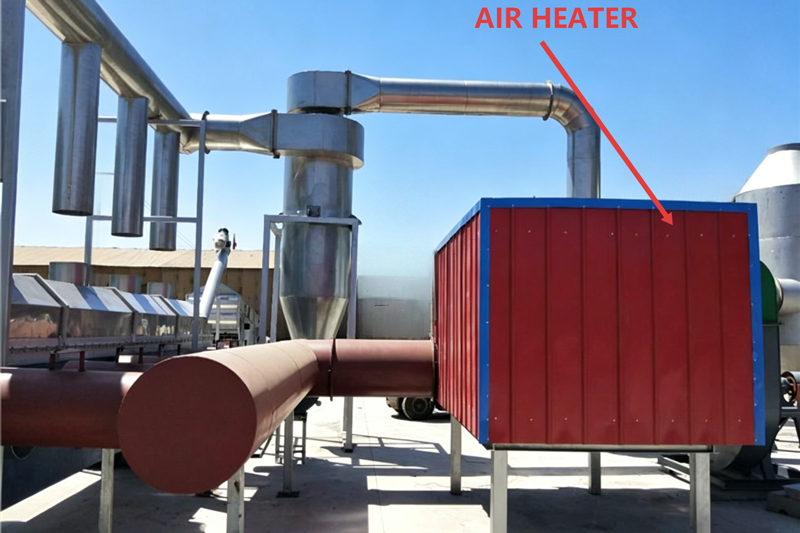
Air Heater
Hot air is provided by the hot air furnace. When the centrifugal dewatering machine is in operation, the air heater heats the ambient air to 80 - 120℃ (adjustable according to the moisture content) and then delivers the clean hot air to the vibrating fluid bed dryer through the air supply system. There are three common types of hot air furnaces:
- Natural gas hot air furnace: A clean energy source with low emissions and rapid heating. It is suitable for areas with convenient natural gas supply, energy-saving and environmentally friendly, and reduces operational pollution.
- Coal-fired hot air furnace: Cost-effective with an abundant fuel supply. It has a strong heat output and is suitable for large-scale salt production. It is easy to maintain and has low operating costs.
- Diesel hot air furnace: Flexible and portable without the need for fixed fuel pipelines. It ignites quickly and provides stable heat, making it suitable for remote areas or temporary production sites.
Vibrating Fluid Bed Dryer
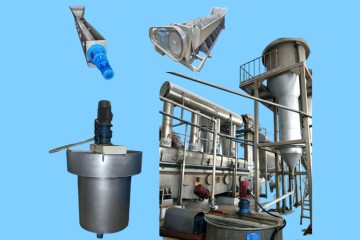
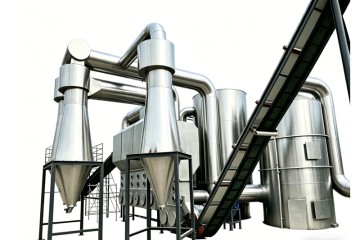
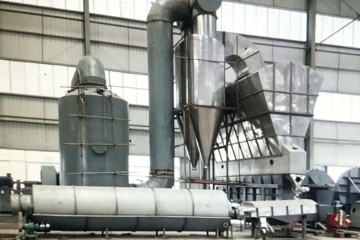
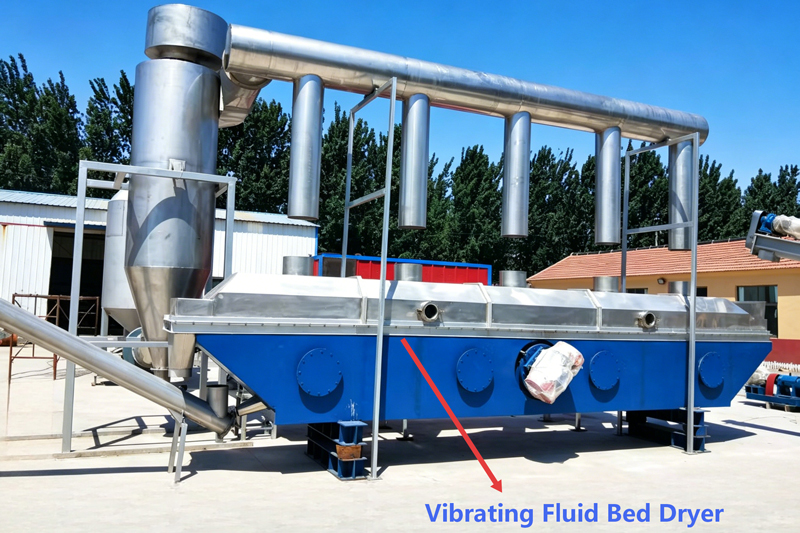
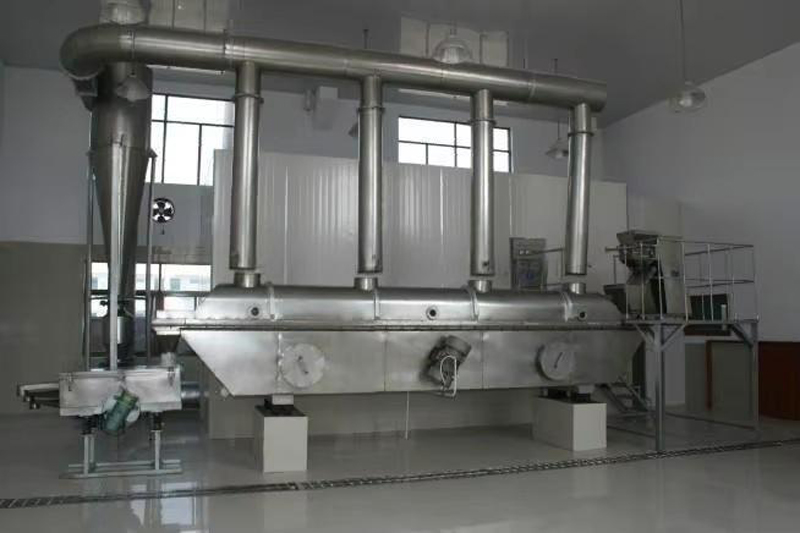
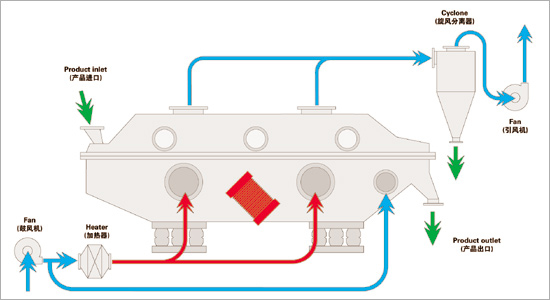
The vibrating fluidized bed dryer is composed of a material system, an air intake filtration system, a heating and cooling system, a main unit, a separation and dust removal system, a discharge system, an exhaust system, and a control system, etc. During operation, the material is fed into the drying chamber by the material feeder. In the drying chamber, the material meets hot and cold air, forming a fluidized state, and heat transfer occurs, completing the drying and cooling process.
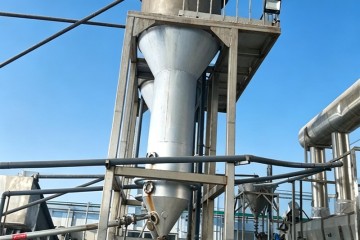
A small amount of fine powder of the material is carried by the air and enters the cyclone separator. Under the action of centrifugal force, the material settles along the wall of the cylinder and is separated. The trace amount of fine powder not separated by the cyclone separator enters the water mist dust collector, where it is captured and recovered, and the wet air is discharged. Control system: It automatically regulates and controls by detecting the pressure at the air intake and exhaust ports and the temperature at the temperature measurement points.
Technological Process
Product Features
- The drying system adopts a two-stage separation and dust removal process with a cyclone separator and a water mist dust collector, achieving high powder recovery rate and effectively reducing material loss. The main unit is equipped with quick-opening holes and drain ball valves of sanitary grade, facilitating cleaning and maintenance. The main unit has undergone structural improvements, featuring a long service life, low vibration, low noise, and uniform material distribution.
- The fluidization is even, without dead corners or blow-through phenomena, ensuring uniform drying and cooling products. The parts in contact with the material are made of stainless steel and undergo acid washing and passivation treatment, with a smooth structure.
- The upper and lower bed bodies of the drying main unit are insulated, providing good insulation effect and minimizing heat loss of the equipment.
- The main bed plate is rigid and has a reasonable opening rate, effectively avoiding the problem of material leakage.
- The exhaust air pipeline is designed with variable diameters at certain sections according to different air volumes to ensure that fine powder does not accumulate.
- The entire system operates under slight negative pressure and is fully enclosed, preventing dust from flying and maintaining a clean working environment.
Technical Specification
| Model | Body | Shape (mm) | Vibration Motor Power (kW) | Weight (kg) | Water Evaporation Capacity (kg/h) | |||
|---|---|---|---|---|---|---|---|---|
| Power (kW) | Weight (kg) | L | W | H | ||||
| ZLG3x0.30 | 300 | 3000 | 3505 | 1830 | 890 | 0.37X2 | 1240 | 30-50 |
| ZLG3x0.45 | 300 | 4500 | 5005 | 1830 | 1116 | 0.75X2 | 1570 | 45-70 |
| ZLG6x0.45 | 600 | 4500 | 5005 | 1940 | 1286 | 1.1X2 | 1967 | 90-150 |
| ZLG6x0.60 | 600 | 6000 | 6510 | 1940 | 1286 | 1.1X2 | 2743 | 120-200 |
| ZLG6x0.75 | 600 | 7500 | 8010 | 1940 | 1286 | 1.1X2 | 2886 | 150-250 |
| ZLG9x0.60 | 900 | 6000 | 6510 | 2110 | 1830 | 2.2X2 | 3540 | 180-300 |
| ZLG9x0.75 | 900 | 7500 | 8010 | 2110 | 1830 | 2.2X2 | 4219 | 220-370 |
| ZLG12x0.75 | 1200 | 7500 | 8010 | 2450 | 2400 | 3X2 | 5223 | 300-500 |
| ZLG15x0.75 | 1500 | 7500 | 8010 | 2570 | 2850 | 4X2 | 6426 | 370-620 |
| ZLG18x0.80 | 1800 | 8000 | 8520 | 3100 | 3250 | 5.5X2 | 8600 | 450-700 |