



What is the industrial application scope of fluidized bed dryer?
The simplest fluidized bed dryer is a single-layer cylindrical type, which has been applied to the drying of materials such as ammonium sulfate, ammonium chloride, anhydrous sodium sulfite, table salt, polytetrafluoroethylene, calcium gluconate, alkaline blue lotus dye, catalyst particles, etc. This dryer is relatively simple to operate, but its disadvantage is that the material has a wide distribution of residence time in the fluidized bed, and the humidity of the dried product is uneven.
The multi-layer fluidized bed dryer overcomes the shortcomings of the single-layer fluidized bed dryer, greatly narrowing the residence time distribution, achieving uniform drying degree of the product, and making it easy to control the drying quality of the product. Due to the reduced residence time and high thermal efficiency, it is suitable for drying materials with longer deceleration drying stages and materials with higher moisture content. It has been applied to the drying of materials such as polyester slices, sodium salicylate, aminophylline, oxytetracycline, aureomycin, tetracycline, tablet starch granulation, sugar powder, etc.
The drying time of the horizontal multi chamber fluidized bed dryer can be adjusted arbitrarily, and a uniformly dried product can be obtained. Suitable for drying various difficult to dry powder materials and heat sensitive materials. Drying of materials such as polyvinyl chloride resin, polypropylene resin, nylon 1010, o-chlorobenzoic acid, oxytetracycline, chloramphenicol, tetracycline, sugar powder, etc.
A stirred fluidized bed dryer is a device that installs a stirrer inside a fluidized bed to enable fluidized drying of certain wet particulate materials or materials that are prone to agglomeration. Can be used for drying materials such as ammonium sulfate, copper sulfate, sodium fluoride, amino acids, casein anhydride, polypropylene resin, phenolic resin, etc.
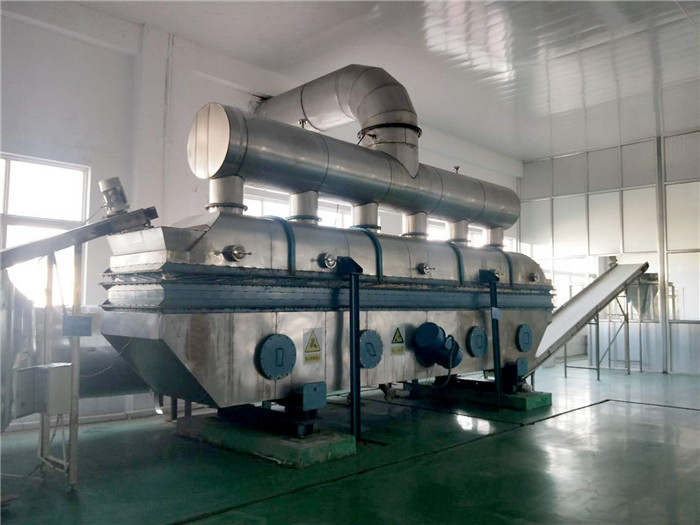
The vibrating fluidized bed dryer is a very successful modified fluidized bed, which applies mechanical vibration to the fluidized bed. The material on the bed mainly moves forward by vibration, and the gas is only used for heat and mass transfer. It can reduce the air volume and pressure required for fluidization compared to a typical fluidized bed. Mainly used in the mining, metallurgy, chemical, pharmaceutical, and food industries for drying materials such as sugar, asbestos minerals, and milk powder.
There is also a belt fluidized bed dryer, which is equipped with a belt conveyor on the bed surface of the fluidized bed and moves forward together with the material. When hot air is blown into the bed surface, the material is fluidized or in a ventilated state, causing surface moisture to evaporate. It has been widely used for drying materials such as compound fertilizers, calcium carbonate, clay, kaolin, clay, grains, distillers' grains, activated sludge, etc.