




Industrial Belt Conveyor from China - Reliable Suppliers & Factory for Mining and Chemical Industries
Core Overview
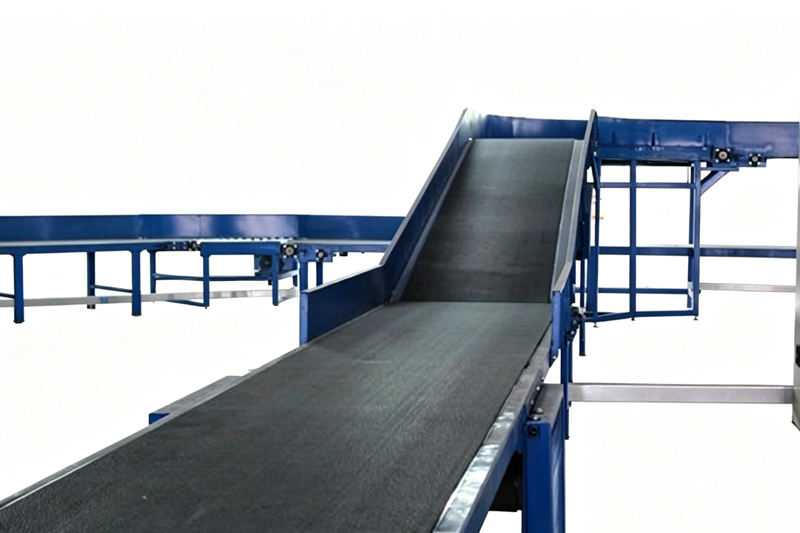
The industrial belt conveyor is an efficient and continuous material conveying equipment, widely used in mining, metallurgy, chemical industry, building materials, grain and other industries. It uses a belt as the carrying and traction component, and the motor drives the drum to rotate, driving the belt to run continuously, realizing long-distance and large-capacity material conveying. This equipment has the characteristics of strong conveying capacity, stable operation, simple operation and low maintenance cost, and can be customized according to different material characteristics and conveying requirements.
| Item | Details |
|---|---|
| Equipment Type | General/Heavy/Light-duty belt conveyor |
| Conveying Capacity | 10t/h-5000t/h |
| Conveying Distance | 10m-1000m |
| Conveying Speed | 0.5m/s-4m/s |
| Belt Width | 500mm-2000mm |
| Automation Level | Manual/semi-automatic/full-automatic control optional |
Applicable Materials
The equipment is suitable for various types of materials, and the specific applicable scope is as follows:
| Material Type | State | Characteristic Requirements |
|---|---|---|
| Ore | Blocky, granular | Hardness ≤HRC60, particle size ≤500mm |
| Chemical Raw Materials | Powdery, granular, liquid | No strong corrosion, temperature ≤150℃ |
| Building Materials | Blocky, powdery | Humidity ≤20% |
| Grain | Granular | No impurities, humidity ≤12% |
| Other Materials | Blocky, granular, powdery | Density ≤2.5t/m³ |
Working Principle of Equipment
The industrial belt conveyor is mainly composed of belt, drum, idler, driving device, tensioning device, braking device and other parts. Its working principle is as follows:
The motor drives the driving drum to rotate through the reducer. Friction is generated between the driving drum and the belt, thus driving the belt to run.
The belt forms a closed loop between the driving drum and the driven drum. The idler supports the belt and reduces the running resistance of the belt.
Materials are evenly distributed on the belt through the feeding device. With the continuous operation of the belt, the materials are conveyed to the designated position, and the unloading is completed through the unloading device.
The tensioning device can adjust the tightness of the belt to ensure sufficient friction between the belt and the drum and prevent the belt from slipping.
When the equipment stops or in emergency situations, the braking device can brake quickly to prevent the belt from continuing to run, ensuring the safety of the equipment and personnel.
Refined Working Procedures
| Step Number | Operation Process | Core Parameter Control |
|---|---|---|
| 1 | Equipment Startup | Check whether all parts of the equipment are normal, start the driving device, and make the belt run at low speed |
| 2 | Feeding Adjustment | Adjust the feeding amount of the feeding device according to the material characteristics and conveying capacity to ensure that the materials are evenly distributed on the belt |
| 3 | Conveying Operation | Adjust the conveying speed to make the belt run stably, and monitor the running state of the belt and the material conveying situation in real time |
| 4 | Unloading Control | Adjust the position and angle of the unloading device according to the unloading requirements to ensure accurate unloading of materials |
| 5 | Equipment Shutdown | Stop feeding, and after all materials on the belt are unloaded, stop the driving device and turn off the equipment |
| 6 | Maintenance and Repair | Regularly check the wear of belt, drum, idler and other parts, and replace worn parts in time; Clean and lubricate the equipment |
Core Advantages of Equipment
| Advantage Category | Specific Content |
|---|---|
| Strong Conveying Capacity | It can realize long-distance and large-capacity material conveying, meeting the needs of large-scale production |
| Stable Operation | High-quality belts and components are adopted, the equipment runs smoothly, the failure rate is low, and continuous production is guaranteed |
| Simple Operation | Equipped with advanced control system, it is easy to operate, and manual, semi-automatic and full-automatic control can be realized |
| Low Maintenance Cost | The equipment has a simple structure, is easy to maintain, has a long maintenance cycle, and reduces the equipment use cost |
| Customized Design | It can be customized according to different material characteristics, conveying distance, conveying speed and other requirements to meet personalized production needs |
| Safe and Reliable | Equipped with perfect safety protection devices, such as emergency braking device, belt slip monitoring device, etc., to ensure the safety of equipment and personnel |
Technical Parameters of Equipment
| Parameter Name | Range |
|---|---|
| Motor Power | 5kW-200kW |
| Reducer Type | Cylindrical gear reducer, bevel gear reducer, planetary gear reducer |
| Drum Diameter | 200mm-1000mm |
| Idler Diameter | 89mm-159mm |
| Belt Material | Rubber, PVC, PU, Nylon |
| Tensioning Method | Screw tensioning, weight tensioning, hydraulic tensioning |
Conveying Capacity Comparison Table
| Belt Width (mm) | Conveying Speed (m/s) | Conveying Capacity (t/h) |
|---|---|---|
| 500 | 0.5 | 10-20 |
| 500 | 1.0 | 20-40 |
| 500 | 2.0 | 40-80 |
| 650 | 0.5 | 20-30 |
| 650 | 1.0 | 30-60 |
| 650 | 2.0 | 60-120 |
| 800 | 0.5 | 30-50 |
| 800 | 1.0 | 50-100 |
| 800 | 2.0 | 100-200 |
| 1000 | 0.5 | 50-80 |
| 1000 | 1.0 | 80-160 |
| 1000 | 2.0 | 160-320 |
| 1200 | 0.5 | 80-120 |
| 1200 | 1.0 | 120-240 |
| 1200 | 2.0 | 240-480 |
| 1400 | 0.5 | 120-180 |
| 1400 | 1.0 | 180-360 |
| 1400 | 2.0 | 360-720 |
| 1600 | 0.5 | 180-250 |
| 1600 | 1.0 | 250-500 |
| 1600 | 2.0 | 500-1000 |
| 1800 | 0.5 | 250-350 |
| 1800 | 1.0 | 350-700 |
| 1800 | 2.0 | 700-1400 |
| 2000 | 0.5 | 350-500 |
| 2000 | 1.0 | 500-1000 |
| 2000 | 2.0 | 1000-2000 |