




Heavy-Duty Conveyor Belt for Salt Washing Production Line - Anti-Corrosion, Food-Grade Material from China Suppliers and Factory
Technical Characteristics
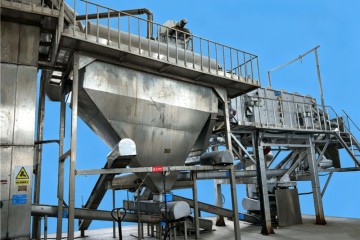
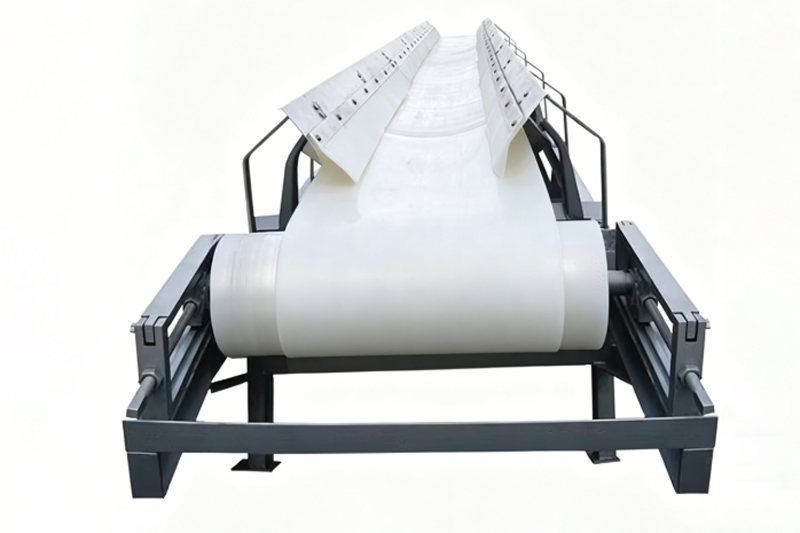
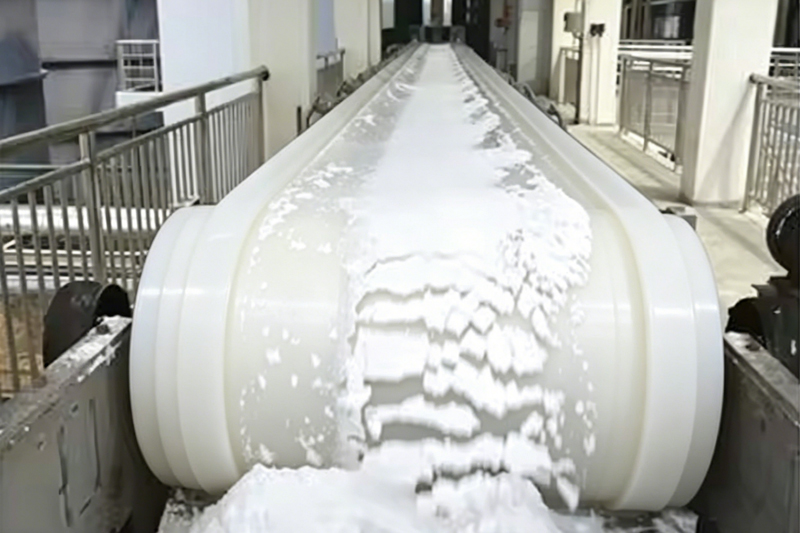
Designed specifically for water-washed salt production lines, this conveyor belt can stably, efficiently and pollution-free transport raw salt, wet water-washed salt and dehydrated salt. It is designed for the highly corrosive conditions in salt production, ensuring smooth material flow throughout the cleaning, dehydration and packaging processes.
The conveyor belt is made of food-grade PU herringbone rubber, and the frame is built with 304/316 stainless steel or galvanized steel to resist salt water corrosion.
Features an inclination angle of ≤ 30° (suitable for climbing), lengths from 3 to 300m, and widths from 500 to 1400mm to suit various layout needs.
Heavy-duty drive with a conveying capacity of 10 - 50 tons/hour. Energy-saving design with a built-in, removable cleaning device and collection trough.
Equipped with a reinforced frame, anti-deviation rollers, and salt leakage prevention. Integrates with salt washing machines, dehydration screens, and packaging lines.
Working Principle
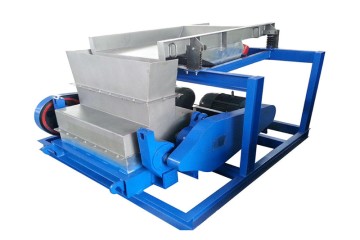
A belt conveyor mainly consists of two rollers and a closed conveyor belt. The roller that provides power is called the drive roller (driving roller); the roller that changes the direction of the conveyor belt's movement is called the redirecting roller. The drive roller is driven by a motor through a reducer, and the conveyor belt is pulled by the friction between the drive roller and the conveyor belt. Materials are fed in at the feeding end, fall onto the rotating conveyor belt, and are transported to the unloading end by the friction of the conveyor belt.
Technical Specifications
TD75 Universal Belt Conveyor Capacity Table:
| Cross-sectional shape | Tape speed (m/s) | Bandwidth B (mm) | |||||
|---|---|---|---|---|---|---|---|
| 500 | 650 | 800 | 1000 | 1200 | 1400 | ||
| Transportation Capacity G (t/h) | |||||||
| Trough shape | 0.8 | 78 | 131 | - | - | - | - |
| 1.0 | 97 | 169 | 278 | 435 | 655 | 891 | |
| 1.25 | 122 | 206 | 348 | 544 | 819 | 1115 | |
| 1.6 | 156 | 264 | 445 | 696 | 1048 | 1427 | |
| 2.0 | 191 | 323 | 546 | 853 | 1284 | 1748 | |
| 2.5 | 232 | 391 | 661 | 1033 | 1556 | 2118 | |
| 3.15 | - | - | 824 | 1233 | 1858 | 2528 | |
| 4.0 | - | - | - | - | 2202 | 2996 | |
| Parallel | 0.8 | 41 | 67 | 118 | - | - | - |
| 1.0 | 52 | 88 | 147 | 230 | 345 | 469 | |
| 1.25 | 66 | 110 | 184 | 288 | 432 | 588 | |
| 1.6 | 84 | 142 | 236 | 368 | 553 | 756 | |
| 2.0 | 103 | 174 | 289 | 451 | 677 | 922 | |
| 2.5 | 125 | 211 | 350 | 546 | 821 | 1110 | |
TD75 Universal Fixed Belt Conveyor Power Selection Table (Unit: kW)
| Length (m) | 15m | 30m | 45m | 60m | 100m | 150m | 200m | 300m | |
|---|---|---|---|---|---|---|---|---|---|
| Tape Width (mm) | 500mm | 1.0 | 1.3 | 1.7 | 2.0 | 3.2 | 4.6 | 8.0 | 11.5 |
| 650mm | 1.3 | 1.9 | 2.4 | 2.8 | 4.6 | 9.2 | 11.5 | 16.0 | |
| 800mm | 1.9 | 2.9 | 3.6 | 4.3 | 9.7 | 14.0 | 17.5 | 24.3 | |
Frequently Asked Questions
1. What materials are used to construct this salt production conveyor belt?
The conveyor belt is constructed using food-grade PU herringbone rubber. The structural frame is built from 304/316 stainless steel or galvanized steel, ensuring high resistance to corrosive salt water and maintaining product cleanliness.
2. What is the maximum inclination angle and conveying capacity of the system?
The conveyor is designed with an inclination angle of ≤ 30°, making it highly suitable for climbing applications. It delivers a stable conveying capacity of 10 to 50 tons per hour depending on configuration.
3. How does the system minimize material loss and maintenance downtime?
It features a built-in cleaning device combined with a removable collection trough. This configuration reduces material loss, prevents salt build-up, and simplifies cleaning to minimize maintenance downtime.
4. Can the conveyor belt dimensions be customized for specific plant layouts?
Yes, the system is highly customizable. The length can range from 3 to 300 meters, and the belt width can be specified between 500 and 1400 mm to seamlessly integrate with your existing factory setup.
5. What parameters are used to calculate the conveying capacity of the TD75 conveyor?
Conveying capacities are calculated based on a standard material bulk density of 1T/m³, a conveying inclination angle of 0°–7°, and a material stacking angle of 30°.