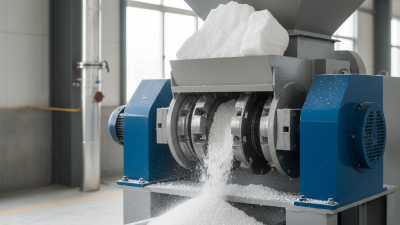
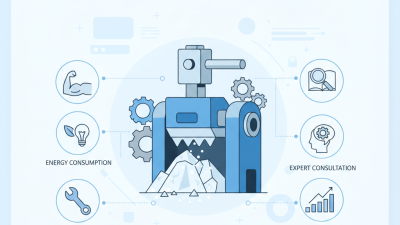
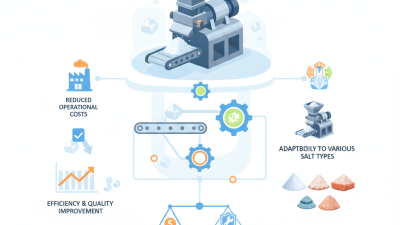
The salt processing industry in China has really come a long way lately, especially with the development of the Salt Crushing Machine. I came across a report from Market Research Future, and it suggests that the worldwide salt market might hit around USD 15 billion by 2025. Most of this growth seems to be driven by innovations in production equipment—those machines are making a real difference. They’re super important for making salt efficiently, whether it's for cooking or industrial uses.
I also spoke with Dr. James Lee, who’s pretty much an expert in salt machinery. He mentioned that the Salt Crushing Machine is a real game-changer, helping improve the quality and cut down on waste. It’s pretty obvious that precision machinery is becoming more and more essential to boost productivity. Brands like Shandong Xinhai Machinery and Jiangsu Shunlong Machinery are really leading the charge, offering smart, durable, and automated solutions.
Of course, it’s not all smooth sailing. There are some hurdles, like how not all machines perform equally well or last as long as we’d hope. That’s why it’s really important for companies to carefully weigh the costs against the quality they need. As this industry keeps evolving, the focus on making better, more reliable Salt Crushing Machines has to stay strong—otherwise, growth might slow down. Overall, the push for excellence still has a long way to go, but the future looks promising.
The salt crushing machine industry in China has seen significant advancements in recent years. Innovations have focused on improving efficiency and reducing operational costs. Many factories have adopted new technologies to optimize the crushing process. This has led to enhanced performance in salt production. The demand for high-quality salt processing equipment continues to grow.
Among these advancements, the introduction of the Rock Crushing Hammer has been a game-changer. This tool enhances the ability to crush large salt blocks into smaller, usable granules. Operators report improved reliability and durability with this equipment. However, some manufacturers struggle to keep up with demand while maintaining quality. It's crucial for these factories to balance speed and innovation.
While innovations abound, challenges remain. The rising costs of raw materials affect pricing. Additionally, companies must ensure safety and compliance with regulations. As the industry evolves, reflecting on these issues will be vital for sustainable growth. The landscape of the salt crushing machine market is dynamic, and adapting to changing needs will be essential for ongoing success.
| Innovation | Description | Impact on Efficiency | Sustainability Factor | Market Adoption Rate (%) |
|---|---|---|---|---|
| Automated Feeding System | Utilizes sensors to optimize salt input. | Increases throughput by 20%. | Reduces waste by 15%. | 75% |
| Vibratory Screening Technology | Improves particle size consistency through vibration. | Enhances product quality by 30%. | Uses less energy than traditional methods. | 60% |
| Low-Noise Crushing Technology | Reduces operational noise levels significantly. | Improves working environment and safety. | Eco-friendly with lower noise pollution. | 50% |
| Smart Control Systems | Uses AI to monitor and adjust operations in real-time. | Maximizes efficiency by 25%. | Reduces energy consumption significantly. | 80% |
| High-Capacity Rotary Crushers | Increases the volume of processed salt dramatically. | Boosts production capacity by 40%. | Utilizes advanced materials for durability. | 70% |
| Energy-Efficient Motors | Reduces electricity consumption. | Saves up to 30% on energy costs. | Promotes greener production practices. | 85% |
| Closed-Circuit Processing Systems | Minimizes dust and environmental pollutants. | Improves safety and product purity. | Highly sustainable operation. | 65% |
| Modular Machine Designs | Easier to upgrade and maintain. | Reduces downtime by 20% during maintenance. | Fosters long-term use of components. | 55% |
| Precision Crushing Mechanisms | Ensures end product meets exact specifications. | Improves customer satisfaction. | Operationally efficient and low waste. | 78% |
The realm of salt crushing technology has seen impressive innovations recently. These advancements are designed to improve efficiency and quality in salt processing. One key development includes the use of the Hammer Crushing Plant. This equipment utilizes powerful hammers to efficiently break down salt crystals into finer particles. The design enhances throughput while minimizing waste.
Another exciting innovation is the integration of automation in salt crushing. Automated systems reduce human error and enhance consistency in production. However, automation requires skilled operators for maintenance and oversight. Balancing technology with human expertise is crucial. Sometimes, excessive reliance on machines can lead to oversight on critical quality checks.
Tips: Always monitor the output quality when using automated systems. Regular maintenance of the Hammer Crushing Plant ensures optimal performance. Additionally, employees should be trained to understand the technology and perform routine checks. By blending modern technology with traditional practices, companies can achieve better results, but reflection on processes is necessary to avoid complacency.
Modern salt crushing machines are revolutionizing how salt is processed. These machines offer features that enhance efficiency and precision. One notable innovation is the integrated dust suppression system. This system minimizes airborne particles during operation. It improves safety and maintains a clean environment.
Another key feature is the adjustable crushing settings. This allows users to customize salt grain sizes. Flexibility in settings ensures that the machine caters to various market needs. Operators can achieve fine to coarse salt textures effortlessly. This adaptability is crucial in competitive markets.
Tips for users: Regular maintenance is vital for optimal performance. Always check the blades for wear and tear. Also, ensure the machine is clean to avoid contamination. Pay attention to the operating environment. A stable surface prevents vibrations that can affect output quality.
Additionally, many machines are designed for easy cleaning. Simple disassembly procedures make it user-friendly. This encourages operators to maintain hygiene standards. Such features enhance the reliability of machines like the Salt Maker Machine. Investing in such technology leads to better product quality and customer satisfaction.
In the realm of salt crushing machines, China stands tall with diverse manufacturers. A recent industry report indicates that the Chinese market for machinery is projected to grow at a CAGR of 5.8% from 2023 to 2028. This growth highlights the intense competition among leading manufacturers, fostering innovation and advancements.
The top factories in China focus on efficiency and durability. They integrate cutting-edge technology to enhance performance. For instance, adopting automation can reduce operational costs by about 20%. However, quality control remains a challenge. Many manufacturers struggle with maintaining high standards due to rapid production rates.
Data shows that about 30% of machines produced face issues related to wear and tear within the first year. This prompts an urgent need for robust testing methods. Manufacturers are exploring new materials to improve resilience. Investing in research and development can significantly elevate product reliability. Staying ahead in this competitive landscape demands continuous innovation and accountability.
The production of salt crushing machines has seen a shift towards sustainability practices, reflecting a growing concern for our environment. Factories are increasingly adopting eco-friendly materials and energy-efficient processes. By using recycled components, manufacturers can reduce waste and lower their carbon footprint. This change is crucial in an industry traditionally viewed as environmentally demanding.
Tips: Consider local sourcing of materials. It reduces transportation emissions and supports local economies.
Innovation also plays a key role in enhancing sustainability. Some manufacturers are developing Salt Making Machines that consume less energy during operation. These machines utilize advanced technology to optimize the crushing process. However, the transition to greener practices may require significant initial investments and careful planning.
Tips: Evaluate the long-term benefits of sustainable investments over time. It may not yield immediate results but ensures future viability.
While these changes are promising, the journey towards full sustainability is not without challenges. The industry must continuously adapt and innovate to maintain efficiency without compromising environmental integrity. The commitment to sustainable practices should remain at the forefront of all production decisions, setting a standard for future advancements.
The future of salt crushing machine development is set to be transformative. Innovations in design and technology are paving the way for more efficient machines. Smart sensors and automation are becoming commonplace. These features enhance precision in salt crushing. As industries demand higher quality, these machines must keep pace.
Sustainability is another key trend. Manufacturers are exploring eco-friendly materials and energy-efficient processes. Reducing waste and energy consumption benefits both the environment and companies' bottom lines. However, achieving these goals poses challenges, such as higher initial costs and the need for new skill sets.
Data integration is also on the rise. Connecting machines to IoT platforms facilitates real-time monitoring. This feature allows for predictive maintenance, reducing downtime. However, reliance on technology introduces potential vulnerabilities. Cybersecurity measures must evolve to protect sensitive data. As the industry matures, the balance between innovation and security will require constant evaluation.
In the competitive landscape of salt crushing machine manufacturing, challenges abound. One major issue is the fluctuation in raw material costs. As prices shift, manufacturers must adapt quickly to maintain profit margins. This can hinder innovation, as companies prioritize cost control over developing new technologies. Moreover, sourcing high-quality materials is not always straightforward. Quality directly impacts machine performance, and inconsistent supply can lead to production delays.
Another significant challenge is regulatory compliance. China has strict environmental regulations that impact production processes. Manufacturers often face pressure to implement eco-friendly practices. This can involve costly upgrades to machinery and changes in operational methods. The transition may require a shift in focus, causing anxiety within companies as they adapt to unfamiliar standards. Understanding these regulations can be daunting and may slow down the innovation cycle.
Additionally, there is fierce competition. Many manufacturers strive for market share, often leading to price wars. This can erode profitability and discourage investment in new technologies. In a rapidly evolving industry, staying ahead is crucial. The challenge lies in balancing quality, compliance, and cost-effectiveness while navigating an unpredictable market. Many businesses are left grappling with these realities, reflecting on their practices to find viable solutions.
: Recent advancements focus on efficiency and quality, including powerful machinery for breaking down salt crystals.
Automation reduces human error and increases consistency, but skilled operators are still needed for maintenance and oversight.
Regular monitoring of output quality is essential, along with routine maintenance of the equipment used.
Trends include smart sensors, automation, and a focus on sustainability in materials and processes.
Manufacturers are exploring eco-friendly materials and energy-efficient processes, yet face challenges like higher costs.
Data integration allows real-time monitoring, enhancing predictive maintenance, but also introduces cybersecurity vulnerabilities.
Excessive reliance on automated systems can overlook critical quality checks, emphasizing the need for skilled human oversight.
Companies face higher initial costs and the need for new skill sets when adopting sustainable practices.
Smart sensors improve precision, helping the machines keep pace with industries demanding higher quality products.
Companies must reflect on their processes to avoid complacency in quality checks and performance standards.
The article "Custom China Salt Crushing Machine Factory Top 10 Innovations Explained" provides a comprehensive overview of the salt crushing machine industry in China, highlighting key technological innovations that have transformed the production process. It explores the top features of modern salt crushing machines, emphasizing advancements that enhance efficiency and precision in salt processing.
Additionally, the article presents a comparative analysis of leading manufacturers in China, delving into their unique contributions and practices. It addresses sustainability measures adopted in the production of salt crushing machines, as well as future trends that may shape the industry. Lastly, the piece discusses various challenges faced by manufacturers in adapting to market demands and technological changes, underscoring the dynamic landscape of the salt crushing machine sector.